
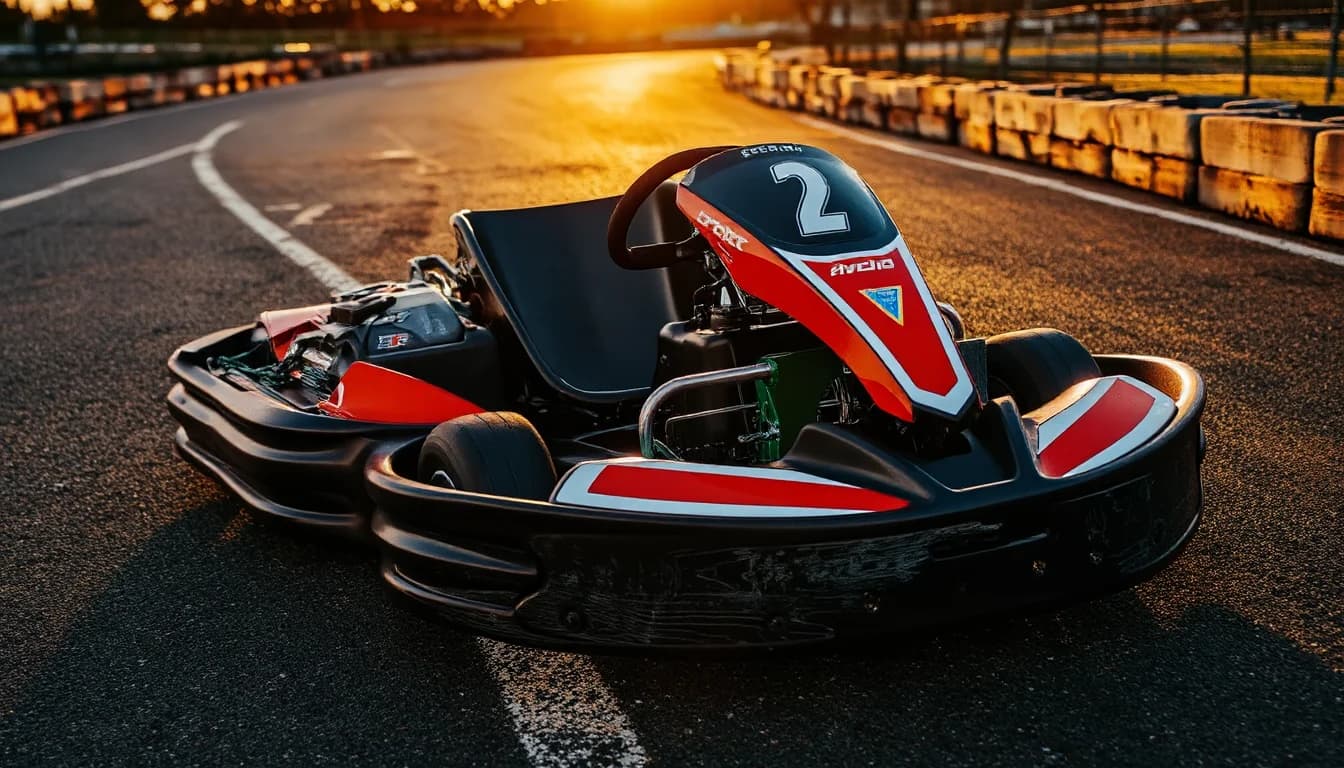
A racing kart and an ordinary road car share very little beyond having four wheels and a combustion engine. The absence of suspension, a differential and any bodywork that could shield the driver from vibration turns the engine into the absolute centre of the experience, and understanding how it works helps explain why karting is regarded as the technical foundation of all motorsport.
The two-stroke cycle behind most kart engines
The vast majority of competition kart engines run on the two-stroke cycle, a design that completes a full power cycle in just two strokes of the piston, one up and one down, per revolution of the crankshaft. On the upward stroke, exhaust and intake of the fuel mixture are completed while it is compressed; on the downward stroke, combustion, gas expansion and the start of the scavenging process that sets up the next cycle all take place.
That mechanical simplicity — fewer moving parts than a four-stroke engine — is exactly what gives two-stroke engines a much higher power-to-weight ratio, since the power stroke happens twice as often for every turn of the crankshaft. In exchange, they demand more frequent maintenance and more careful tuning, particularly around the exhaust valve systems that regulate their behaviour across different rev ranges.
Why the four-stroke engine still has its place
Not every kart out there runs a two-stroke engine. Four-stroke engines, in which intake and exhaust are regulated by an independent valve system, are usually adapted versions of air-cooled industrial engines with more modest outputs, generally between 5 and 20 horsepower. This is the standard solution for beginner karting and a large share of rental fleets, where durability and low maintenance matter more than outright power.
This coexistence of two very different engine philosophies explains why a first rental session and a first licensed race can feel like almost different sports in terms of throttle response, even though the chassis and the underlying driving logic remain essentially the same.
From Mini to Senior: how engines evolve in the Spanish Championship
The Campeonato de España de Karting (CEK), organised by the RFEDA, is a good illustration of how the machinery changes with a driver's age and experience. The Mini category uses the Watershift 60 RL engine, designed for the youngest drivers taking their first steps in licensed competition, with a Mini Rookie subcategory for those who have just picked up their licence.
By the time drivers reach Junior and Senior, the reference engine becomes the IAME X30 125cc, capped at 16,000 RPM according to its homologation sheet and fitted with a homologated Tillotson HW-27A carburettor. It is telling that Junior and Senior share the same engine specification: progression between categories depends less on a jump in displacement than on chassis development, driver experience and the rest of the technical rules that apply to each age group.
Gearbox karting: the KZ category
Above the direct-drive categories sits KZ, the main gearbox class in competitive karting. Unlike an OK or X30 kart, where the engine sends power straight through with no gear ratios involved, a KZ driver operates a sequential gearbox that adds a whole extra layer of technical complexity and driving skill. Its KZ2 variant shares the same engine specification as KZ, differing only in chassis and brake rules, which are more open in the KZ World Championship.
Driving with a gearbox requires coordinating clutch, gear changes and braking in a way that simply does not exist in direct-drive categories, which is why it tends to be reserved for drivers with more prior karting experience.
OK: the international reference for direct-drive engines
Internationally, the OK category replaced the older KF engines in 2016 as the top reference for direct-drive karting, available from age 14 in the world championships. These are two-stroke engines with no gearbox that have evolved from earlier standards, such as the 125cc KF1 engines with a 16,000 RPM rev limiter introduced in 2007, into today's OK specification, designed to keep competition close between engine manufacturers.
This constant evolution of technical regulations is typical of karting: international governing bodies periodically adjust displacement, rev limits and homologated components to preserve safety and a level playing field between drivers.
Why it's worth understanding your engine
Knowing these nuances is not just trivia for the enthusiast. Understanding whether the kart you are about to drive has a two-stroke or four-stroke engine, whether it has a gearbox, and what rev limit its homologation sheet sets helps explain why it responds to the throttle the way it does, why it demands a particular style of driving, and why moving up a category means far more than simply gaining displacement.
In the end, every kart engine — from the simplest four-stroke to a gearbox-equipped KZ unit — is a piece of engineering designed for a very specific purpose: delivering the most efficient possible power-to-weight ratio within the rules of its category, which is exactly what makes karting as valuable a technical education as it is a driving one.
That is also why technical scrutineering before and after every race is such a visible part of any licensed competition weekend. Technical stewards check that each kart's engine, carburettor and homologated components match exactly what its category allows, sealing parts and checking rev limits to make sure no driver races with an unauthorised mechanical advantage. It is the less visible flip side, away from the grandstands, of everything that happens under the bonnet of a racing kart.
Reviewed by the GoKarting editorial team before publication.